Sunday, October 3, 2010

100% Fruit Juice Improves Children's Diet

Consumption of 100 percent fruit juice is closely linked to improved nutrient intake and overall diet quality in children and teens, according to researchers at the Louisiana State University Agricultural Center and Baylor College of Medicine

The researchers used data from the 2003-2006 National Health and Nutrition Examination Survey (NHANES) to compare the diets of juice drinkers to non-consumers.

According to the findings, children 2-5 years of age who consumed fruit juice had significantly higher intakes of vitamin C, potassium, and magnesium and significantly lower intakes of added sugars compared to non-fruit juice consumers.

In addition, higher intake of fruit juice was directly correlated with increased consumption of whole fruits and whole grains.

Children 6-12 years of age showed a similar positive association between intake of 100 percent juice and higher intakes of the key nutrients, as well as dietary fiber. Overall diet quality, as assessed by the Healthy Eating Index (a measure that evaluates conformance to federal dietary guidance) was higher in all fruit juice consumers assessed.

The researchers reported that a significantly higher percentage of non-fruit juice consumers 2-18 years of age failed to meet the recommended levels for several key nutrients, including vitamins A and C and folate, compared to those who drank 100 percent juice. Comparatively, a greater percentage of those in the fruit juice group exceeded Adequate Intake levels for calcium versus non-consumers.

"One hundred percent fruit juice plays an important role in the diets of children and teens, supplying important nutrients during a key period of growth and development," notes lead researcher Dr. Carol O'Neil. "Drinking 100 percent juice should be encouraged as part of an overall balanced diet."

Source: Juice Products Association

Friday, October 1, 2010

Goodbye Nut Allergies

Johns Hopkins scientists have discovered a way to turn off the immune system's allergic reaction to certain food proteins in mice, a discovery that could have implications for the millions of people who suffer severe reactions to foods, such as peanuts and milk.

The findings, published online in the journal Nature Medicine, provide hope that the body could be trained to tolerate food allergies that lead to roughly 300,000 emergency room visits and 100 to 200 deaths each year.

The research team, led by Shau-Ku Huang, Ph.D.,discovered that one kind of immune cell in the gastrointestinal tract called lamina propria dendriti cells (LPDC) -- considered the first line of defense for a body's immune system -- expresses a special receptor, SIGNR1, which appears on the cells' surface and binds to specific sugars.

By targeting this receptor using sugar-modified protein, researchers were able to keep food proteins that would have induced a severe, even deadly, allergic reaction from causing any serious harm.

"There is no cure for food allergies, and the primary treatment is avoidance of the offending protein," Zhou says. "This could teach our bodies to create a new immune response and we would no longer be allergic to the protein."

The researchers hope to confirm whether this promising process in mice can also occur in people.

Wednesday, September 29, 2010

Blueberries Fight Artery Hardening

A new U.S. Department of Agriculture (USDA)-funded study offers the first direct evidence that blueberries help fight atherosclerosis, also known as hardening of the arteries.

The study compared the size, or area, of atherosclerotic lesions in 30 young laboratory mice. Half of the animals were fed diets spiked with freeze-dried blueberry powder for 20 weeks; the diet of the other mice did not contain the berry powder.

Lesion size, measured at two sites on aorta (arteries leading from the heart), was 39 and 58 percent less than that of lesions in mice whose diet did not contain blueberry powder.

Earlier studies, conducted elsewhere, have suggested that eating blueberries may help combat cardiovascular disease. But direct evidence of that effect has never been presented previously.

The blueberry-spiked diet contained 1 percent blueberry powder, the equivalent of about a half-cup of fresh blueberries.

All mice in the investigation were deficient in apolipoprotein-E, a trait which makes them highly susceptible to forming atherosclerotic lesions and thus an excellent model for biomedical and nutrition research.

In followup studies, researchers hope to determine whether eating blueberries in infancy, childhood and young adulthood would help protect against onset and progression of atherosclerosis in later years. Early prevention may be especially important in light of the nation's epidemic of childhood obesity. Overweight and obesity increase atherosclerosis risk.
  • Sources: Principal investigator Xianli Wu, based in Little Rock, Ark., with the USDA Agricultural Research Service (ARS) Arkansas Children's Nutrition Center and with the University of Arkansas for Medical Sciences, led the investigation. The findings are reported in the current issue of the Journal of Nutrition.
  • Farm Produce
  • Blueberries

Friday, July 23, 2010

40 Best Age-Erasing Superfoods

The "40 Best Age-Erasing Superfoods," according to Tollie Schmidt of Tollie International Inc., and based on "the latest science on muscle-building, brain-enhancing, wrinkle-erasing, heart-strengthening, bone-protecting, immunity-boosting, and inflammation-fighting foods."

1. Almonds
2. Flaxseeds
3. Tomatoes
4. Sweet Potatoes
5. Spinach
6. Rosemary
7. Wild Salmon
8. Blueberries
9. Green Tea
10. Dark Chocolate
11. Tuna
12. Carrots
13. Dried Plums
14. Whole Grains
15. Red Wine
16. Yogurt
17. Avocado
18. Walnuts
19. Turmeric
20. Black Beans
21. Apples
22. Alaskan King Crab
23. Pomegranates
24. Bok Choy
25. Oysters
26. Broccoli
27. Kiwis
28. Olive Oil
29. Leeks
30. Artichokes
31. Chili Peppers
32. Ginger
33. Cinnamon
34. Eggs
35. Figs
36. Grass-Fed Beef
37. Mushrooms
38. Pineapples
39. Fruit or Vegetable Juice
40. Bing Cherries

Monday, July 5, 2010

Olive Oil + Mediterranean Diet Fight Heart Disease by Changing How Genes Function

A traditional Mediterranean diet with liberal amounts of virgin olive oil rich in polyphenols lowers the risk for cardiovascular disease because these foods change how genes associated with atherosclerosis function, according to a new research report published in the Federation of American Societies for Experimental Biology Journal.

Scientists worked with three groups of healthy volunteers. The first group consumed a traditional Mediterranean diet with virgin olive oil rich in polyphenols. The second group consumed a traditional Mediterranean diet with an olive oil low in polyphenols. The third group followed their habitual diet. After three months, the first group had a down-regulation in the expression of atherosclerosis-related genes in their peripheral blood mononuclear cells. Additionally, the olive oil polyphenols made a significant impact on the expression of genetic changes influencing coronary heart disease.

Results also showed that the consumption of virgin olive oil in conjunction with a Mediterranean diet can positively impact lipid and DNA oxidation, insulin resistance, inflammation, carcinogenesis, and tumor suppression.

Source: Federation of American Societies for Experimental Biology

Olive Oil
Photo: Dipping Olive Sprig with Black Olives in Olive Oil
The Mediterranean Diet

The Color of Honey

The color (of honey) is associated with the specific flower and the mineral content of the nectar. In general, the darker the color of the honey is, the bolder the flavor.

For example, dark honeys such as buckwheat or heather are much stronger in flavor than light-colored orange blossom and clover honeys. Basswood, with its water-white color and strong, somewhat biting flavor, is an exception.


Due in part to their higher protein content, darker-color honey promotes surface browning of products that are baked, cooked, and roasted. Accordingly, choose light-colored honey when sweetening foods and beverages, where its golden hue is more appropriate. White honey is ideal when no additional color is desired.

from New Good Food: Essential Ingredients for Cooking and Eating Well by Margaret M. Wittenberg

Honey

Monday, June 7, 2010

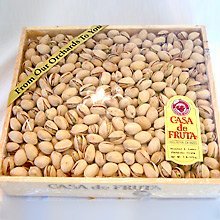
Pistachios Boost Antioxidants

Pistachio nuts, eaten as part of a healthy diet, can increase the levels of antioxidants in the blood of adults with high cholesterol, according to a new study by an international team of researchers.

"Our previous study showed the benefits of pistachios in lowering lipids and lipoproteins, which are a risk factor for heart disease," said Penny Kris-Etherton, Penn State professor of nutrition. "This new study shows an additional effect of pistachios so now there are multiple health benefits of eating pistachios."

The researchers note in the May 20 issue of the Journal of Nutrition that "pistachios are high in lutein, beta-carotene and gamma-tocopherol relative to other nuts; however, studies of the effects of pistachios on oxidative status are lacking."

Beta-carotene is the precursor to vitamin A and gamma-tocopherol is a common form of vitamin E. Lutein is found in dark green leafy vegetables and is important in vision and healthy skin. All three compounds are oil soluble vitamins.

Antioxidants are of interest because oxidized low-density lipoproteins (LDL) are implicated in inflammation and plaque buildup inside blood vessels. Antioxidants should prevent LDLs from oxidizing, migrating into the blood vessel walls and causing inflammation.

"Currently, studies on antioxidants do not show major benefits," said Kris-Etherton. "Maybe we are not studying people long enough. Maybe there is something in the food that travels with the antioxidants. The antioxidant story is very disappointing to the scientific community."

The reason for the disappointment is that studies on specific antioxidants currently do not show health benefits, but epidemiological studies seem to indicate benefits. Many people feel that we have not figured out antioxidants yet, said Kris-Etherton.

If antioxidants are important, then pistachios fit the bill as antioxidant-laden food.